Africa has always been high on my travel wish list, although over the years it has tended to be countries such as South Africa, Kenya and Botswana that first caught my attention. Namibia somehow remained slightly under the radar, but the more I discovered about its extraordinary landscapes and wildlife, the more I began to wonder why.
This is a country of enormous open spaces, towering desert dunes, rugged mountains and a wild Atlantic coastline. There are opportunities to experience some of Africa’s great wildlife, but Namibia offers something very different from the traditional image of a safari holiday. The landscapes are every bit as important as the animals, and travelling between them becomes part of the adventure.
My introduction to Namibia came through Icelandic travel specialist Rannveig Snorradóttir, who has visited the country several times and describes it as somewhere that stays with you long after you return home.
When Rannveig originally shared her experiences with Just One For The Road, she divided Namibia into four places that particularly captured what she loved about the country: the Namib Desert, Swakopmund, Damaraland and Etosha National Park.
It’s quite a journey.
Planning a trip to Namibia? Take a look at my Namibia Travel Guide for more ideas, places to visit and practical information for exploring the country.
The Extraordinary Namib Desert
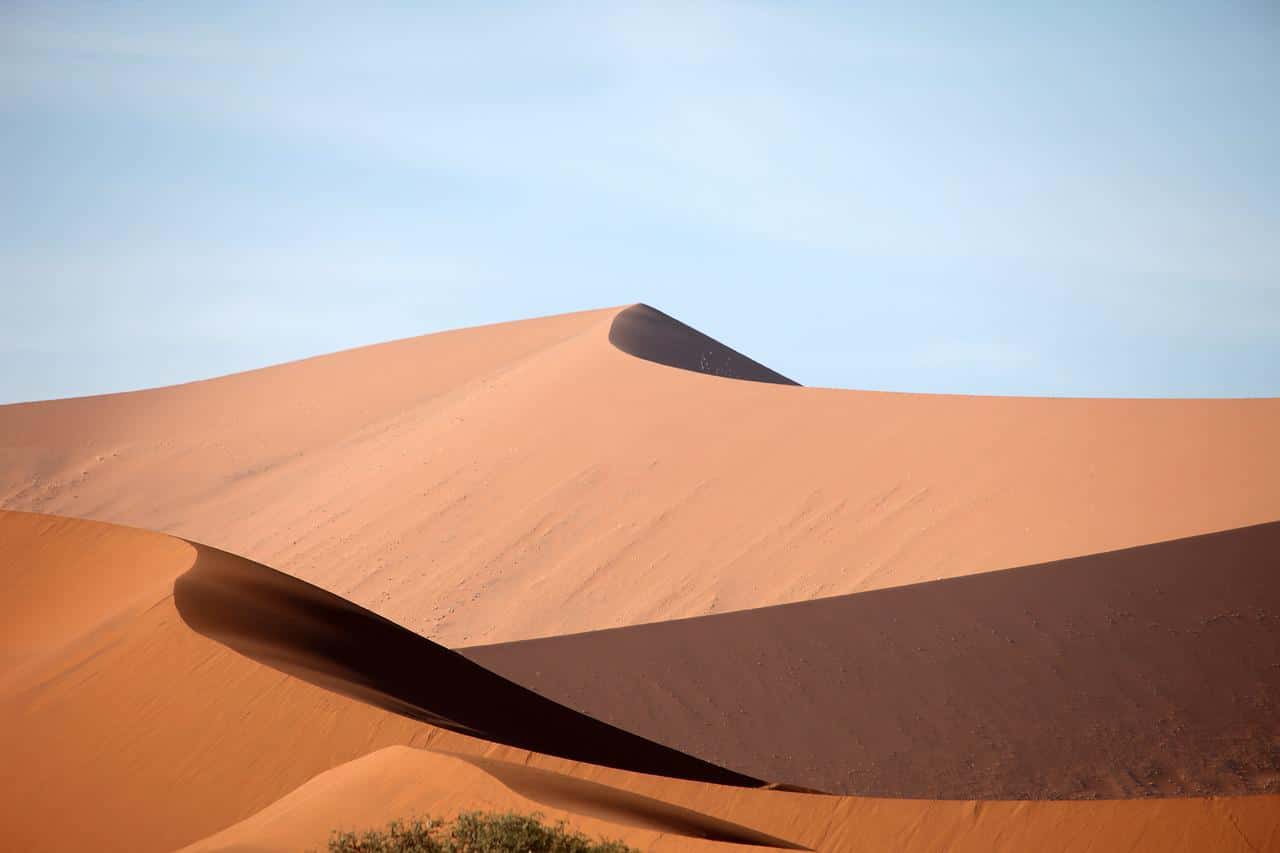
There are few landscapes more closely associated with Namibia than the enormous red dunes of the Namib Desert.
For Rannveig, one of the great experiences is arriving at Sossusvlei, where immense dunes rise above pale desert pans and change colour as the light moves across them. Sunrise is particularly beautiful, when the first light creates deep shadows along the ridges and transforms the sand into shades of red, orange and gold.
Nearby Deadvlei provides one of Namibia’s most extraordinary sights. The white clay pan is scattered with the dark skeletons of ancient camel thorn trees, surrounded by towering orange-red dunes. The contrast between the white ground, blackened trees, blue sky and surrounding sand creates a landscape that hardly seems real.
One of the great challenges here is climbing Big Daddy, one of the highest dunes in the Sossusvlei area. Walking up sand is considerably harder than it looks, particularly as the temperature begins to rise, but the views from higher on the dune provide a wonderful perspective across the desert.
The descent is considerably easier and a lot more fun. Rather than carefully retracing every step, you can make your way down the steep sand towards Deadvlei below, which Rannveig remembers as one of the most enjoyable parts of the experience.
🏜️ Desert Tip: Start early if you’re planning to explore the dunes around Sossusvlei and Deadvlei. Apart from the beautiful morning light, you’ll appreciate avoiding the stronger heat later in the day.
Swakopmund Between Desert and Ocean
After the silence and enormous landscapes of the desert, Swakopmund provides a complete change of atmosphere.
Sitting on Namibia’s Atlantic coast with the Namib Desert immediately behind it, the town is a popular base for adventure activities and exploring the surrounding coastline. Its German colonial architecture provides another contrast, creating a place that can occasionally feel slightly surreal given its position between desert and ocean in southwestern Africa.
For Rannveig, much of Swakopmund’s appeal lies in the sheer choice of things to do.
One of the most spectacular excursions heads south towards Sandwich Harbour, where enormous dunes descend towards the Atlantic. Travelling through this landscape in a suitable 4×4 provides a dramatic reminder of how closely Namibia’s desert and ocean environments meet.
Boat trips from nearby Walvis Bay offer opportunities to see marine wildlife, while heading back into the desert reveals creatures that are considerably smaller but equally fascinating.
Guided Living Desert experiences search for animals adapted to survive amongst the seemingly empty dunes. Geckos, lizards, snakes and other small desert creatures can be remarkably difficult to spot until somebody who understands the landscape shows you where to look.
For those wanting more adrenaline, the dunes around Swakopmund have become associated with activities including sandboarding, quad biking and scenic flights. Even skydiving is possible, with the desert on one side and Atlantic Ocean on the other providing a backdrop that would be difficult to replicate anywhere else.
What I like about Swakopmund is that it provides a break in the journey without really providing a break from the adventure. You can spend one day exploring the desert and the next out on the ocean before continuing north into another completely different Namibian landscape.
Into the Wild Landscapes of Damaraland
Damaraland was another of Rannveig’s Namibia highlights, and this is where the sense of space becomes particularly apparent.
The region is characterised by rocky mountains, dry riverbeds and vast open landscapes, with settlements scattered across an environment that can initially appear almost empty.
It is also associated with Namibia’s desert-adapted elephants. These aren’t a separate species of elephant, but animals that have adapted their behaviour to survive in the arid landscapes of northwestern Namibia, travelling considerable distances between sources of food and water.
Tracking them with experienced local guides provides a very different wildlife experience from watching animals gather around a permanent waterhole. The landscape is enormous and sightings aren’t guaranteed, which makes encountering elephants moving through the dry river valleys particularly memorable.
Damaraland also has an important human history and is home to communities including the Damara people. The wider region contains archaeological and cultural sites, including the famous rock engravings at Twyfelfontein, making this somewhere worth spending time rather than simply driving through on the way to Etosha.
For Rannveig, however, it was the combination of landscape and wildlife that made the greatest impression. Seeing elephants surviving in such an apparently unforgiving environment changes your understanding of how adaptable these animals can be.
Wildlife Tip: Namibia’s desert-adapted elephants live in a fragile environment. Travel with responsible guides who understand their movements and maintain appropriate distances rather than attempting to approach them for photographs.
Safari in Etosha National Park
No journey through Namibia would feel quite complete without experiencing Etosha National Park, one of the country’s great wildlife destinations.
At its heart lies the enormous Etosha Pan, a vast salt pan that dominates the landscape and gives the national park much of its distinctive character. For much of the year it appears dry and almost endless, although seasonal rains can dramatically alter parts of the environment.
The wildlife experience around Etosha is particularly associated with its waterholes.
In a dry landscape, water naturally becomes a focal point for animals, which means sometimes the best safari experience involves doing very little at all. Rather than constantly driving in search of the next sighting, you can simply wait and see what arrives.
Elephants, giraffes, zebras and numerous species of antelope can all be encountered within the park, alongside predators and Namibia’s important rhino populations. Every waterhole is different and every day brings the possibility of something unexpected.
Rannveig recommends allowing several days rather than trying to experience Etosha in a single hurried visit, and I can understand why. Safari is one of those experiences where more time generally means more opportunities to appreciate animal behaviour rather than simply collecting photographs of different species.
She particularly remembers sitting quietly beside a waterhole and watching wildlife arrive to drink and bathe. In a world where we increasingly seem determined to fill every moment of a holiday with another activity, there is something rather appealing about simply stopping and watching Africa unfold in front of you.
A Country Made for a Road Trip
What particularly interests me about Namibia is how naturally these different experiences fit together as a journey.
You can begin amongst the enormous dunes around Sossusvlei, travel towards the Atlantic at Swakopmund, continue through the wild landscapes of Damaraland and eventually reach the wildlife-rich plains of Etosha.
The distances are significant, but in Namibia that seems to be part of the attraction. Travelling through huge open landscapes and watching the scenery change is not simply the time between destinations; it is part of experiencing the country.
Namibia has therefore become one of Africa’s great road-trip destinations, although planning is important. Distances between fuel, accommodation and services can be considerable, road surfaces vary and driving after dark is generally something to avoid because of wildlife and other hazards.
For anyone uncomfortable tackling those conditions independently, travelling with an experienced driver-guide provides another way of experiencing the same journey while benefiting from local knowledge.
Road Trip Tip: Don’t underestimate distances in Namibia. A route that looks straightforward on a map may involve long stretches of gravel road, so build enough time into your itinerary and avoid trying to cover too much in one day.
Namibia After Dark
There is another side to Namibia that only really reveals itself once the sun disappears.
With vast areas of the country having very little artificial light, Namibia offers exceptional opportunities for stargazing. In remote desert regions, the night sky can become every bit as memorable as the landscapes during the day.
This is particularly true around some of the country’s desert reserves, where clear skies and minimal light pollution reveal a night sky that can be difficult to imagine if you live close to a large town or city.
After a day surrounded by dunes, wildlife or enormous empty landscapes, sitting outside beneath the stars seems a suitably Namibian way to finish the evening.
It also reinforces something that runs throughout Rannveig’s experiences: Namibia isn’t a country that needs constant entertainment. Much of its appeal comes from the scale, silence and emptiness of the landscape itself.
Why Namibia Deserves More Attention
The more I learn about Namibia, the more surprised I am that I overlooked it for so long.
It offers the African wildlife experiences I have always dreamed about, but combines them with something completely different. There are enormous desert dunes, a wild Atlantic coastline, ancient rock art, adventure activities, remote communities and landscapes where sometimes the horizon seems to go on forever.
Rannveig has returned to Namibia more than once, and listening to her describe the country makes it easy to understand why.
Sossusvlei provides the spectacular desert scenery, Swakopmund introduces adventure and the Atlantic coast, Damaraland brings wilderness and desert-adapted wildlife, while Etosha delivers the classic safari experience.
Together they create a journey through a country that feels wonderfully different from the African destinations I had traditionally considered.
Namibia may once have been missing from my travel wish list, but it certainly isn’t anymore.
About This Namibia Experience
This article is based on the travels of Icelandic travel specialist Rannveig Snorradóttir, who has visited Namibia several times and originally shared some of her favourite experiences with Just One For The Road.
Her original contribution has been updated while retaining the four places that particularly captured her love of the country: the Namib Desert, Swakopmund, Damaraland and Etosha National Park.